
HTTPCS EASM solution identifies exposed assets and maps your external attack surface
Adopt an attacker’s perspective and identify the assets of your organization exposed on the Internet. The HTTPCS EASM solution analyzes your digital ecosystem to detect domains, subdomains, IP infrastructures, and publicly accessible services.
This visibility into your external attack surface helps you quickly identify resources accessible from the Internet, better control your online presence, and reduce the risk of exploitation by cyber attackers.
With HTTPCS EASM, easily manage and control your external attack surface.
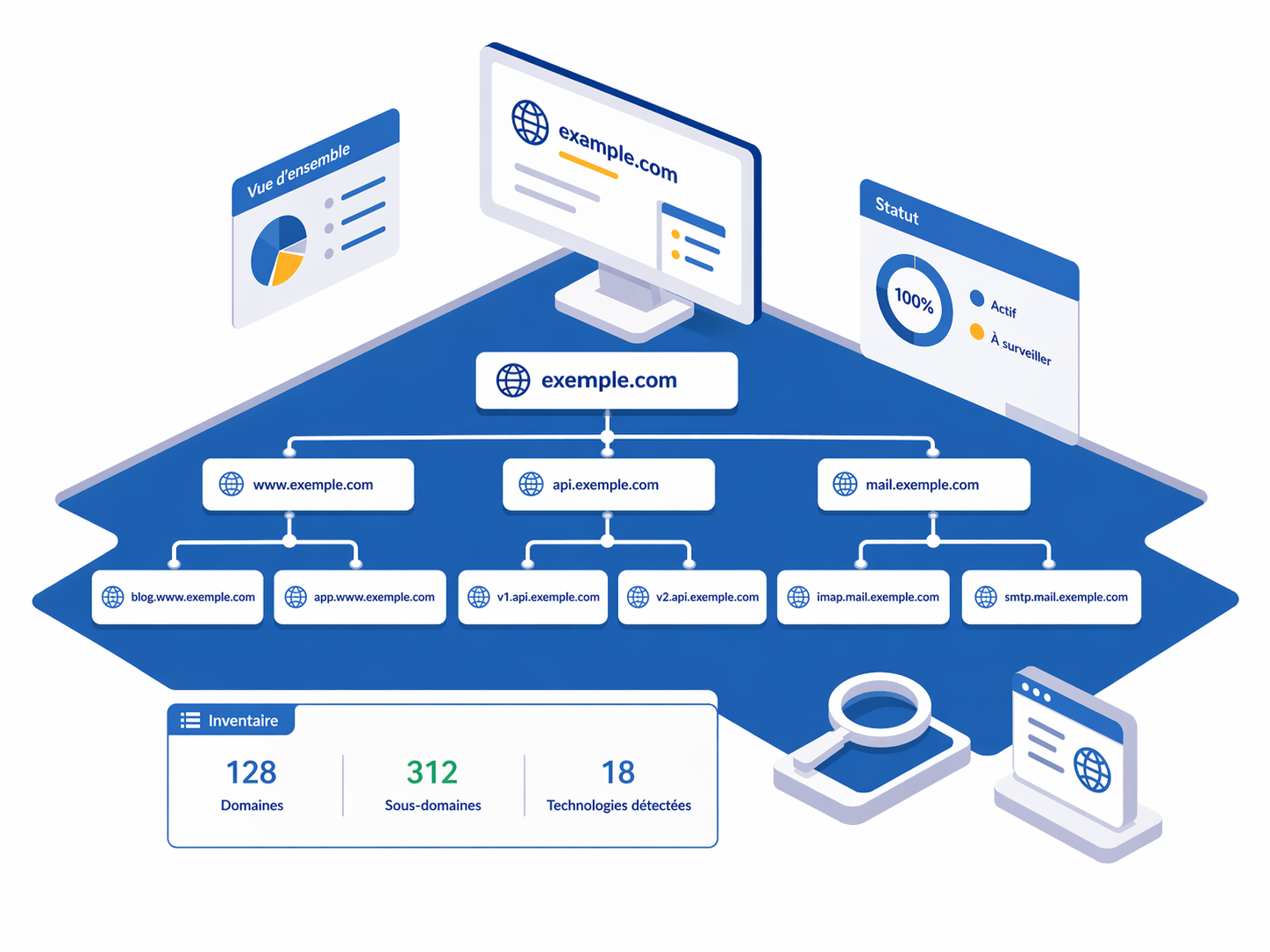
Map and secure your entire external attack surface
The HTTPCS EASM solution enables you to automatically identify, analyze, and monitor all assets exposed on the Internet.
Websites, subdomains, cloud infrastructures, public IP addresses, network services, or other domains belonging to your organization may be exposed without security teams always being aware of them.
HTTPCS EASM provides a complete and dynamic mapping of your external attack surface, allowing you to quickly detect exposed resources and reduce the risk of exploitation by cyber attackers.
This discovery capability reveals assets sometimes unknown to IT teams, such as abandoned projects, test environments, or infrastructures created by different departments.
You gain a complete view of your exposed perimeter.
Classification of exposed assets
Not all detected assets have the same level of criticality.
The EASM solution analyzes their activity to distinguish:
• Active and operational sites
• Obsolete sites
• Abandoned or unmaintained resources
• The structure of your digital assets
This classification helps prioritize actions, whether securing, updating, or removing certain resources.

Technical visibility into exposed Infrastructures
HTTPCS EASM also provides technical visibility into infrastructures associated with detected assets. For each identified domain, the platform displays associated public IP addresses, as well as services accessible from the Internet, including service name, open port, and protocol used (e.g., SSH – 22/TCP or HTTPS – 443/TCP), technologies in use, and CVE security advisories.
Additional information is available to better understand the technical environment of each asset, such as host details, DNS nameservers, and the location of hosting providers and servers.
These elements give security teams a detailed view of network exposure and external configuration, facilitating analysis of the architecture visible from the Internet and identification of potentially exposed services.
✔ Complete visibility of your external attack surface
✔ Discovery of unknown or forgotten assets
✔ Analysis of exposed IP infrastructures
✔ Identification of accessible network services
✔ Continuous monitoring of changes
✔ Prioritization of security actions
With HTTPCS EASM, your organization gains continuous visibility into its Internet exposure, a key element in strengthening its cybersecurity posture.
In many organizations, resources remain accessible on the Internet without supervision.
EASM analyses often reveal :
• Legacy or abandoned websites
• Exposed test applications
• Forgotten subdomains
• Unreferenced public IP addresses
• Cloud services created by different departments
• Vulnerable network configurations
• Domains related to the organization (brands, subsidiaries, projects, or services) not necessarily sharing the same domain name
These assets represent attack opportunities for cybercriminals.
HTTPCS EASM helps identify them to reduce risks.
Continuous monitoring of your attack surface
An organization’s attack surface is constantly evolving.
New services may be deployed, cloud infrastructures added, or subdomains created without security teams being informed.
HTTPCS EASM ensures continuous monitoring of exposed assets to detect:
• The appearance of new infrastructures
• The opening of new services
• The creation of new subdomains
• New technologies and deprecated versions
• Newly disclosed security vulnerabilities (CVE)
The solution analyzes collected data to help security teams prioritize remediation actions.
Teams can :
• Identify critical network services
• Detect unmaintained resources
• Focus efforts on the most significant risks
This approach improves cybersecurity team efficiency and quickly reduces the vulnerable attack surface.

Assets identified by the HTTPCS EASM (External Attack Surface Management) solution can be directly integrated into other HTTPCS platform solutions to enhance monitoring and security.
Detected websites and applications can be added to the HTTPCS Security vulnerability scanner to perform automated security audits and identify exploitable flaws. Discovered assets can also be monitored with HTTPCS Monitoring to track availability and performance, or analyzed with HTTPCS Integrity to detect suspicious modifications, malicious code injection, or file tampering.
Additionally, HTTPCS CyberVigilance provides a Threat Intelligence dimension by monitoring data leaks, mentions of the organization, and sensitive information circulating on the web, deep web, and dark web. This expands visibility beyond technical assets by also detecting information-related threats.
This integrated approach enables a comprehensive cybersecurity strategy:
• Discover and map the external attack surface
• Analyze detected assets for vulnerabilities
• Continuously monitor services and integrity
• Identify informational threats and data leaks
They trust us












Ziwit (HTTPCS) has the VISA
The PASSI qualification is a security VISA issued by the ANSSI (National Agency for the Security of Information Systems). This certificate issued by ANSSI bears witness to our skills and expertise as auditors, but also to the attention we pay to protecting the integrity of the confidential information to which we may have access during our services to our customers.

Ziwit (HTTPCS) holds the label
Ziwit (HTTPCS) expert in digital security, guarantees technical expertise as well as quality advice to prevent acts of cyber-surveillance and secure your IT installations and your websites.
As an ExpertCyber certified service provider, Ziwit (HTTPCS) is committed to respecting its charter of commitments.
Ziwit (HTTPCS) holds the label
The France Cybersecurity label offers the guarantee that the labeled products, solutions and services are designed, developed and operated in France, by a dynamic and innovative industrial sector recognized by the market. It is therefore a mark of excellence for companies.
Ziwit (HTTPCS) holds the label Qualiopi
QUALIOPI is the unique quality certification mark for training organizations. It has been mandatory since January 1, 2022. ZIWIT fully complies with the 32 new indicators in the national quality reference framework, organized around 7 quality criteria. Our training courses can therefore be referenced by accredited organizations and are eligible for funding.
Ziwit (HTTPCS) is part of the national systemcyber malicious
mission is to support victims of cyberattacks through its cybersecurity solutions and tools.
As a service provider listed on the french government platform Cyber Malicious, Ziwit (HTTPCS) is committed to respecting its charter of commitments.
Our C)PTE certified cybersecurity experts (CERTIFIED Penetration Testing Engineer)
Developed on the basis of the US Force One methodology, and accredited by both the NSA and the FBI, this certification allows us to explore all the existing technical and non-technical means of accessing an information system in an illicit way. Our pentesters are trained in the art of ethical hacking and the latest techniques in penetration testing, with the aim of recognizing each key element: Information gathering, scanning, enumeration, exploitation and reporting.

Our CEH certified cybersecurity experts (Certified Ethical Hacker)
Our pentesters are experienced in vulnerability research. They have the internationally recognized CEH certification to guarantee you a qualified and ethical technical auditor.
Ziwit is certified OSCP (Offensive Security Certified Professional)
OSCP is an ethical hacking certification offered by Offensive Security (or OffSec) that teaches penetration testing methodologies and the use of the tools included with the Kali Linux distribution. The OSCP is a hands-on penetration testing certification, requiring holders to successfully attack and penetrate various live machines in a safe lab environment.
Ziwit is certified OSCP (Practical Network Penetration Tester)
Delivered by TCM Security, the PNPT certification is a unique ethical hacking exam that evaluates a pentester's ability to perform a professional level network penetration test and its potential to perform open source research (OSINT) to gather information on how to properly attack that network. Our pentesters know how to make the most of their Active Directory exploitation skills to perform A/V and egress bypasses, lateral and vertical network movements, and ultimately compromise the domain controller under investigation.
Ziwit (HTTPCS) holds the Cyber Essentials certification
Cyber Essentials is a certification supported by the British government (United Kingdom) to help organizations ensure operational security against cyber attacks.

Ziwit holds the IASME GDPR certification
Issued by the IASME consortium and supported by the UK Government, "IASME GDPR" reinforces Cyber Essential by validating Ziwit's GDPR skills, and its ability to comply with its requirements. IASME GDPR certification is proof that ZIWIT has taken enhanced measures to protect your business and your data from cyber-attacks on the Internet.

Ziwit (HTTPCS) holds the Cybersecurity Made In Europe certification
The "Cybersecurity made in Europe" certification is designed to promote European cybersecurity companies and increase their visibility on the European and global market. The certification raises awareness of the strategic value of cybersecurity companies originating in Europe and developing their activity on the basis of European values of trust.

Ziwit (HTTPCS) is a member (Alliance for digital trust)
ACN is a group of companies that award services, solutions and technologies that mitigate risk and therefore increase trust.

Ziwit (HTTPCS) is an associated memberCampus Cyber
Campus Cyber will be a French hub of cybersecurity by 2022 that will bring together the main national and international players in the field.
Full
Managed Services
Our SaaS HTTPCS solutions can be fully managed so you can benefit from the expertise of product engineers to optimize your vulnerability management.
Contact usFrequently Asked Questions about EASM
What is EASM?
External Attack Surface Management (EASM) is a cybersecurity approach that involves identifying, analyzing, and monitoring all Internet-exposed assets associated with an organization.
This includes websites, subdomains, public IP addresses, network services, and publicly accessible cloud infrastructures.
The goal is to provide security teams with a complete view of their external attack surface to identify exposed resources and reduce risks.
How do you use an EASM solution?
Using an EASM solution is simple and fast.
You just need to add your organization’s main domain to the platform. From this, the solution automatically analyzes the associated digital ecosystem and discovers exposed assets and related domains.
The solution continuously and automatically maps your external attack surface without complex configuration.
What types of assets can be detected?
An EASM solution can identify various types of Internet-exposed assets, including:
• Domains and subdomains
• Websites and web applications
• Public IP addresses
• Accessible network services
• Exposed cloud infrastructures
• Test environments or forgotten services
• Other domains belonging to the organization
This discovery helps identify resources sometimes unknown to IT or security teams.
How often is the attack surface analyzed ?
The EASM solution continuously monitors assets associated with your organization.
This allows rapid detection of:
• New subdomains
• Newly exposed infrastructures
• Newly opened network services
• Changes in the external environment
Security teams are quickly informed of new exposures.
Who is an EASM solution for?
EASM solutions are mainly used by
• CISOs (Chief Information Security Officers)
• SOC teams
• IT and infrastructure teams
• Cybersecurity teams
They improve visibility over exposed assets and strengthen the organization’s overall cybersecurity posture.
What is the difference between EASM and a vulnerability scanner?
EASM and vulnerability scanners are complementary:
• EASM: identifies exposed assets and maps the external attack surface
• Vulnerability scanner: analyzes assets to detect security flaws within a defined scope
EASM identifies what needs to be secured, while vulnerability scanners detect technical weaknesses.
What is the difference between ASM and EASM?
Attack Surface Management (ASM) refers to the overall management of an organization’s attack surface, including internal and external assets.
External Attack Surface Management (EASM) focuses specifically on assets exposed on the Internet, those visible and potentially accessible to external attackers.
EASM provides an external view of the organization, similar to what a cybercriminal might see.

